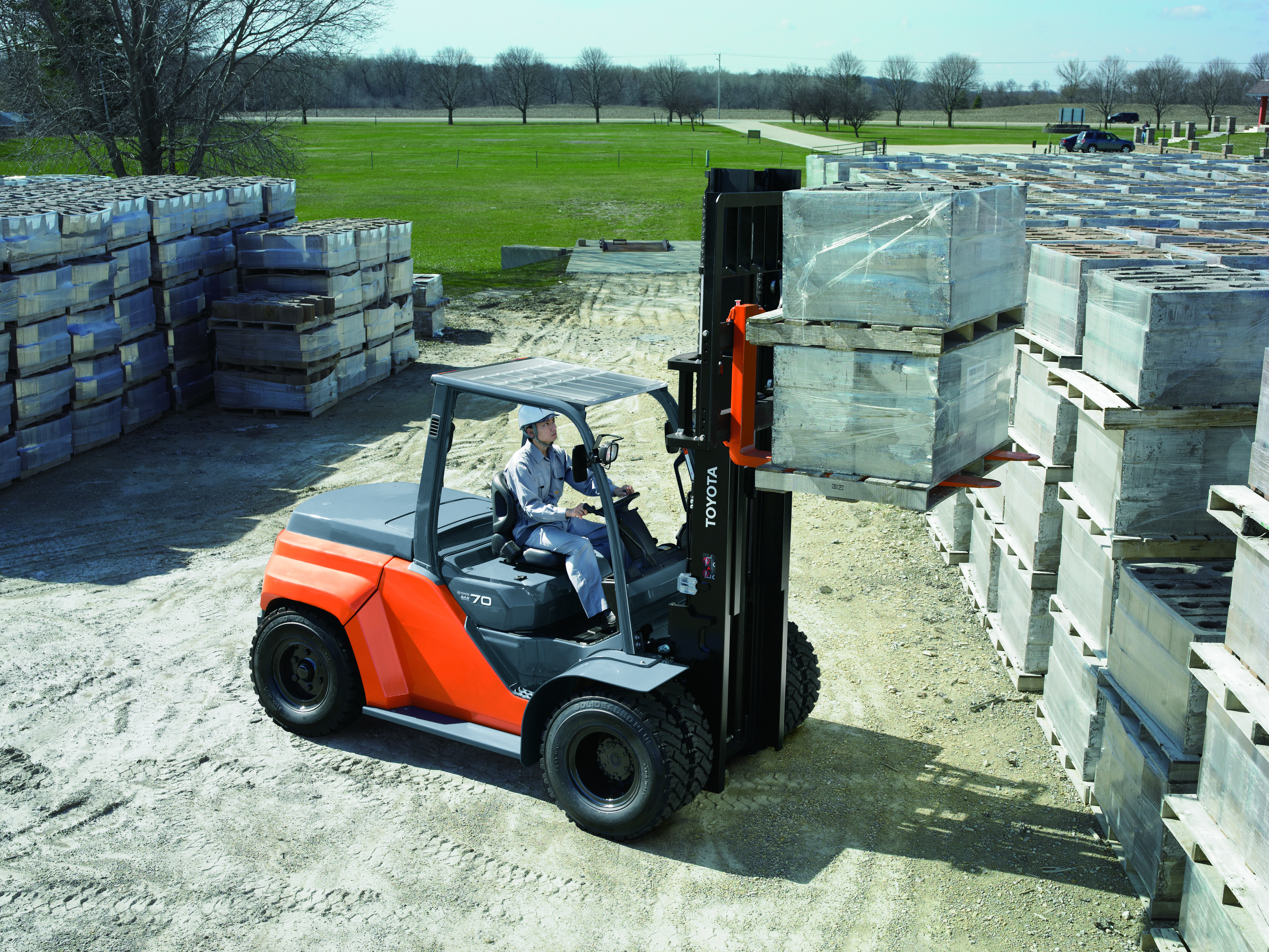
Diesel and gasoline forklifts offer different advantages depending on operational requirements. Diesel forklifts deliver high power and torque, making them ideal for heavy-duty outdoor applications and steep ramps. Conversely, gasoline forklifts provide greater maneuverability, quiet operation, and lower pollution, making them best suited for semi-indoor environments that require fast cycle times and strict pollution control.
In warehouse and industrial operations management, a "forklift" plays a core component that keeps the supply chain performance. However, choosing the right propulsion system is a critical strategic decision that heavily impacts long-term operating costs—especially when comparing diesel and gasoline forklifts to see how they differ. Although they appear similar, each is designed to meet different operational requirements and working environments.
What is a Diesel Forklift and What Applications Is It Suitable For?
A diesel forklift is an engine-powered forklift powered by diesel fuel and recognized for its high torque at low speeds. Known for delivering outstanding lifting power and durability, diesel forklifts are ideal for heavy-duty applications and demanding operations. Their robust engine design supports long working hours while maintaining consistent performance, making them a reliable choice for handling heavy loads efficiently:
- Outdoor Operations : Because diesel engines possess high weather resistance and a rugged structure, they handle sun and rain exceptionally well. This makes them the right choice for outdoor loading yards.
- Heavy-Duty Lifting : Suitable for moving standard weights up to heavy-industry loads, such as lifting steel, cement, or transferring cargo from shipping containers.
- Sloped or Rough Terrain : High torque helps the vehicle drive up inclines smoothly and steadily, even when loaded to maximum capacity.
What is a Gasoline Forklift and What Applications Is It Suitable For?
A gasoline forklift is an engine-driven forklift that operates similarly to a standard passenger car. It often comes equipped with a dual-fuel system, utilizing both gasoline and Liquefied Petroleum Gas (LPG). Its key highlights are driving agility, responsive acceleration, and quieter operation compared to diesel engines. It is best suited for the following types of work:
- Semi-Indoor Operations: Since its exhaust emissions are cleaner and less pungent than diesel fumes, it can be operated inside buildings that have adequate ventilation.
- Noise-Sensitive Tasks: Ideal for factories located near communities or warehouses where employees must work in close proximity to the vehicle, helping to reduce noise pollution.
- Fast-Paced Work: With its highly responsive acceleration, it is perfect for lifting medium-sized loads where speed and fast turnaround times are paramount.

What Is the Difference Between Diesel vs. Gasoline Forklifts?
Understanding their differing strengths allows us to match the right forklift to the job accurately. The differences can be summarized as follows:
- Power vs. Agility: A diesel forklift provides steady, heavy-duty lifting power for intense applications, while a gasoline model offers better agility and less operational vibration.
- Emissions and Noise: Gasoline forklifts are more environmentally friendly, producing lower soot emissions and quieter operations. In contrast, diesel forklifts may produce more visible smoke and a louder engine noise, which is natural for diesel engines.
- Durability: In terms of structural design, diesel forklifts possess excellent strength and high heat tolerance, often resulting in a longer lifespan when subjected to heavy, back-to-back shifts.
Operating Costs and Maintenance: What Business Owners Need to Know!
For business owners who want to know the hourly operating cost of a diesel forklift and how to calculate fuel expenses, you can use this simple formula:
- Calculation Formula: Average consumption rate (Liters/Hour) x Current fuel price
- Example: A 2.5-ton forklift consumes an average of approximately 2.5 to 3.5 liters of fuel per hour, depending on the severity of the application. If diesel fuel costs 33 Baht per liter, the fuel cost will be around 82.5 to 115.5 Baht per hour.
How to Maintain Diesel Forklift and Gasoline Forklifts: What Should Be Checked Before Operation?
To minimize the chances of operational downtime and extend the lifespan of your machine, operators should perform a daily inspection checklist as follows:
- Cooling System: Check the water level in the radiator to ensure it is not dry, and inspect the condition of the cooling fan.
- Lubrication: Constantly check the engine oil and hydraulic oil levels to ensure they meet standard requirements.
- Filtration System: Regularly clean the air filter system. An obstructed filter causes the engine to consume significantly more fuel.
- Tires and Brakes: Check tire tread conditions, air pressure, and brake efficiency before starting every shift to ensure maximum safety.
For expert guidance on choosing the right regarding internal combustion forklifts, Toyota Material Handling Thailand offers comprehensive warehouse and logistics consulting services. Backed by reliable forklift solutions, industry-leading durability, and the exclusive SAS safety system, our team helps businesses improve productivity, reduce long-term operating costs, and maximize return on investment (ROI) through efficient material handling solutions.
Contact us for an internal combustion forklift quotation at:
- Phone : 02-4949-155
- Email : Info@tmhth.toyota-industries.com
ข้อมูลอ้างอิง
- Which forklift fuel type is the best option for you?. สืบค้นเมื่อวันที่ 8 พฤษภาคม 2569 จาก https://blog.toyota-forklifts.co.uk/which-forklift-fuel-type-is-the-best-option-for-you
Frequently Asked Questions About Diesel and Gasoline Forklifts (FAQs)
Q : Can a diesel forklift be used outdoors? What types of applications and environments suit it best?
A : Yes, it can. Diesel forklifts are specifically engineered with high weather resistance against both intense sunlight and rain moisture. Therefore, they are highly suitable for outdoor loading yards, construction sites, or building material manufacturing plants that require driving over rough, uneven, or sloped terrain.
Q: Can a diesel forklift be retrofitted with an LPG gas system to reduce costs?
A : No, it cannot. This is because diesel and gasoline engines possess completely different ignition systems. LPG conversion systems are compatible only with gasoline engines. If you want to optimize fuel savings on a diesel forklift, you should focus on keeping the air filters clean and ensuring the fuel injection system is perfectly maintained.
Q: Which type of forklift should be chosen for an enclosed warehouse with limited ventilation?
A : If you must choose between these two types, a gasoline forklift (especially one running on an LPG system) is more appropriate because it produces fewer emissions. However, if the warehouse is completely enclosed or is a food/pharmaceutical facility, it is highly recommended to consider an Electric Forklift instead to ensure 100% safety from air pollution.
Q : Which forklift type holds a better resale value: diesel or gasoline?
A : Generally, diesel forklifts maintain a more stable resale value due to the inherent durability of diesel engines, which are built to handle heavy use for tens of thousands of hours. They also remain in high demand across construction industries and outdoor logistics operations.